Engineered Lumber Vs Dimensional Lumber: Framing Your Custom Home
May 13, 2026 | Category: Framing Resources
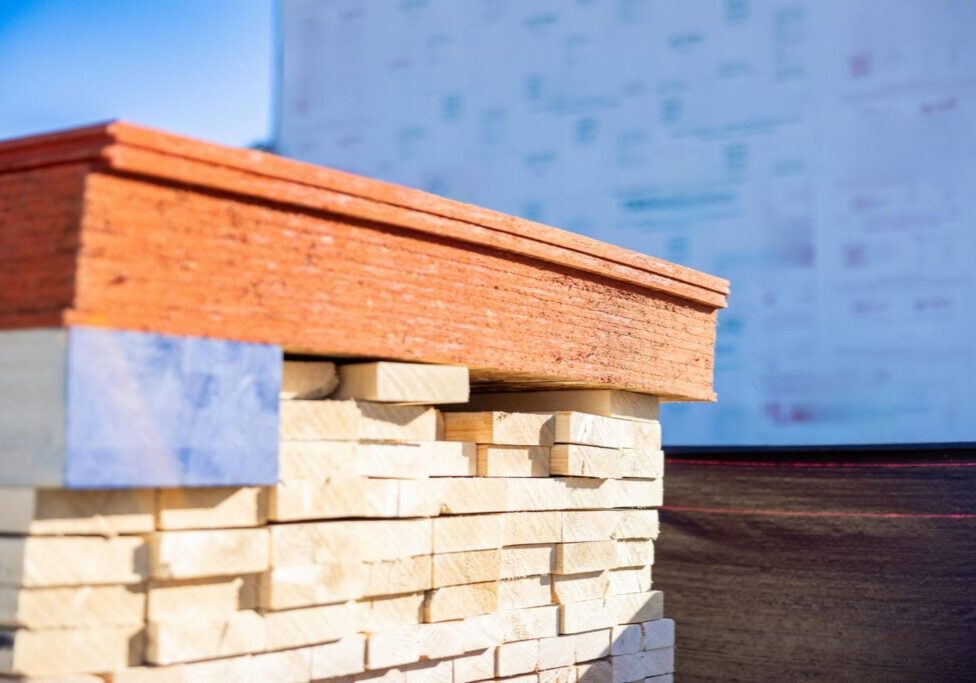
Engineered lumber is usually the better choice for long spans, large openings, structural beams, floor systems, and design details that need predictable strength or straighter material. Dimensional lumber is still the right fit for many studs, plates, blocking, short spans, and conventional wood frame details. In custom home framing, the best answer is rarely one or the other. A well-built frame uses the right material in the right place, based on the approved drawings, engineer’s details, site conditions, and trade coordination.
This choice matters because framing material affects more than the lumber order. It can change room spans, ceiling heights, mechanical routes, floor performance, inspection documents, site handling, and the sequence of the build. On a custom home, the right material package helps the structure match the design without forcing field fixes later.
The final lumber package should follow the approved structural drawings, supplier layouts, municipal requirements, and engineer’s details. A framing crew can advise on buildability, sequencing, site access, and field coordination, but structural substitutions should be reviewed before installation.
Engineered Lumber Vs Dimensional Lumber At A Glance
Engineered lumber and dimensional lumber both belong in custom home framing. Dimensional lumber is sawn wood in standard sizes, such as 2×4, 2×6, 2×8, 2×10, and 2×12. Engineered lumber is manufactured from wood strands, veneers, laminations, webs, or flanges to create structural members with more predictable performance.
The right choice depends on the design, not preference alone. A custom home may use dimensional lumber in most walls, I-joists in the floor system, LVLs over large openings, PSLs at concentrated loads, and glulam where structure and appearance both matter.
| Material | Common Examples | Best Uses | Main Benefits | Watchouts |
| Dimensional Lumber | 2×4, 2×6, 2×8, 2×10, 2×12 | Studs, plates, blocking, short spans, rafters, conventional wall and roof framing | Familiar, flexible, widely available, efficient for repetitive framing | Can vary in crown, twist, shrinkage, length, moisture, and strength by grade and species |
| Engineered Lumber | I-joists, LVL, PSL, LSL, glulam, rim board | Long spans, beams, headers, floor systems, large openings, point loads, complex custom details | Predictable performance, longer spans, straighter members, efficient structural design | Requires correct layouts, handling, installation details, engineering, and supplier coordination |
“Engineered” does not automatically mean better in every location. Overusing engineered products can add cost and coordination where dimensional lumber would perform well. The goal is not to make the frame more complicated. The goal is to match each member to the load, span, finish expectation, and build sequence.
What Dimensional Lumber Does Well In A Custom Home Frame

Dimensional lumber remains a core framing material because it is practical, familiar, and fast to install. Even on a complex custom home, much of the frame still depends on clean, accurate, repeated carpentry. Walls, plates, blocking, backing, bracing, and many conventional roof areas often use dimensional lumber because it fits the work.
The key is selection and placement. A trained crew does not treat every board the same. Straight pieces go where straightness matters, crowned members are oriented with intent, and offcuts are managed so waste does not take over the site.
Studs, Plates, Blocking, And Conventional Roof Framing
Dimensional lumber is commonly used for wall studs, top plates, bottom plates, blocking, backing, nailers, short-span joists, conventional rafters, and many roof framing details. It is often the most efficient material where loads are repetitive and spans are modest.
This matters on custom homes because complex projects still include many standard framing tasks. A large architectural home may have engineered beams and I-joists, but it still needs clean stud walls, properly aligned plates, accurate backing, and careful blocking for cabinets, fixtures, railings, trim, and finishes.
Dimensional lumber also gives the crew flexibility in the field. It can be cut, carried, sorted, and adjusted more easily than many engineered members, which makes it useful for everyday framing details that do not require a proprietary layout or special handling.
Where Dimensional Lumber Saves Time And Cost
Dimensional lumber is often more economical for conventional framing locations. It is usually easier to source, easier to modify, and efficient for repetitive work. For blocking, backing, short walls, bracing, nailers, and many standard assemblies, dimensional lumber can be the right choice without adding unnecessary complexity.
That does not mean it is always cheaper once the full project is considered. Total cost depends on labour, waste, lead times, span requirements, structural design, site access, and rework risk. A member that costs less per piece can still become expensive if it forces extra posts, complicated built-up framing, or field changes.
A good framing plan looks at material cost and labour value together. The question is not only “What does this piece cost?” It is also “Does this material help the crew build accurately, protect the schedule, and support the design?”
Where Dimensional Lumber Starts To Limit The Design
Dimensional lumber can become less efficient where the design calls for longer spans, large openings, flush beams, open-concept layouts, heavy point loads, or tighter floor performance. In those areas, conventional lumber may require more posts, deeper members, or built-up assemblies that fight the architecture.
Natural variation also matters. Dimensional lumber can crown, twist, shrink, or move with moisture. Those traits are normal, but they need to be managed. If the wrong piece is used in a high-precision area, it can affect drywall, cabinets, glazing, trim, floors, or exterior finishes.
Bottom line: dimensional lumber is essential, but it has limits. A custom home frame should respect those limits before the crew is forced to solve structural or finish problems in the field.
What Engineered Lumber Does Well In A Custom Home Frame
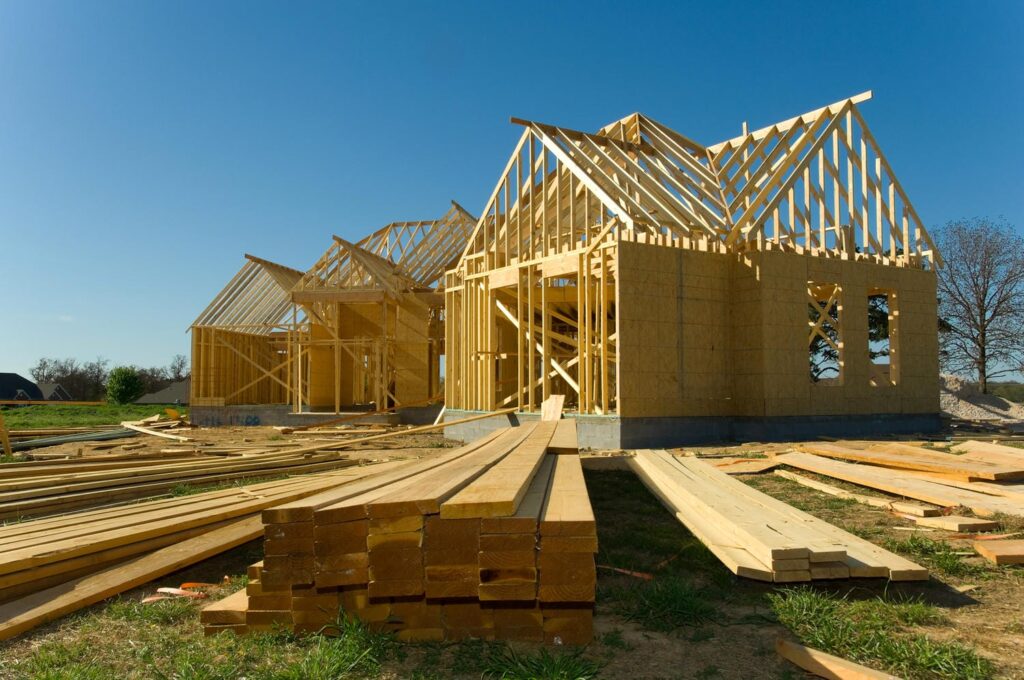
Engineered lumber is used where the structure needs predictable strength, longer spans, straighter members, or cleaner load transfer. Instead of relying only on sawn lumber, engineered products use manufactured assemblies to meet specific structural needs.
In custom homes, engineered lumber often appears where the design pushes beyond conventional framing. Large rooms, open kitchens, tall glazing, flush beams, long floor spans, and complex rooflines can all drive the need for engineered members.
I-Joists For Floors And Roofs
Wood I-joists are common in floor and roof assemblies because they can span farther, stay straighter, and create a more consistent system when designed and installed correctly. They are often used where the home needs open spaces below, predictable floor performance, or planned routes for services.
I-joists also help coordinate mechanical, plumbing, and electrical rough-ins when the supplier’s rules are followed. Web openings may be allowed in certain locations, but those openings are not a free-for-all. Hole size, spacing, bearing, web stiffeners, squash blocks, rim board, hangers, and blocking may all need to follow the layout and installation details.
A framing crew should not install I-joists like standard 2x joists. The material performs well when the package is understood, protected, and installed as specified.
LVL, PSL, LSL, And Glulam For Beams, Headers, And Point Loads
LVL, or laminated veneer lumber, is often used for beams, headers, and structural members that need predictable strength. PSL, or parallel strand lumber, can be used where concentrated loads are high. LSL, or laminated strand lumber, may be used for straight studs, rim, beams, or other engineered framing conditions. Glulam can work where strength matters and the member may also be visible.
These products show up in custom home drawings because the architecture asks more from the frame. Large windows, lift-and-slide doors, open rooms, heavy point loads, vaulted spaces, and long sightlines all need clean structural support.
The framer’s job is not to redesign these members on site. The job is to understand the approved details, confirm bearing, coordinate connectors, install the material properly, and raise questions before anything is cut or covered.
Why Engineered Products Need Supplier And Engineering Coordination
Engineered products usually require more coordination than a loose pile of framing lumber. The crew may need I-joist layouts, beam schedules, truss drawings, hanger schedules, special fasteners, supplier notes, and engineer review before installation begins.
This is where an experienced wood frame contractor adds value. The framer should understand how the engineered package fits the drawings, how it affects install order, and where site conditions may create conflicts before material is cut.
Late changes can be expensive. If a beam is missing, an opening changes, or a mechanical route conflicts with an engineered member, the project may need supplier input or engineering direction. Good coordination reduces those surprises.
Where Each Material Fits In The Frame
It helps to think about the frame by area, not just by material. Floors, walls, beams, headers, openings, and roofs each ask different things from the lumber package. Some parts of the home need flexibility and speed. Others need longer spans, tighter tolerances, or engineered load transfer.
A strong custom home frame often blends both approaches. Dimensional lumber handles much of the repeated carpentry. Engineered lumber handles the areas where the design needs more structural performance or better predictability.
Floor Systems
Dimensional joists can still work for shorter spans and conventional layouts. They are familiar, easy to install, and practical where the design does not demand long spans or special performance. In many smaller areas, they remain a sensible choice.
Engineered I-joists are common where the home needs longer spans, flatter floors, or planned service routes. Floor performance also depends on spacing, span, joist depth, sheathing, blocking, fastening, bearing, and design criteria. The material choice is only one part of the system.
A floor system is not judged only by whether it stands up. It affects ceiling height, mechanical routing, sound, vibration, tile performance, drywall finish, and the feel of the finished home.
Walls And Tall Walls
Most standard walls still use dimensional lumber. Studs, plates, blocking, backing, and bracing can be framed efficiently with conventional material when the loads and heights are within the design requirements.
Engineered studs or laminated members may appear where walls are tall, heavily loaded, or supporting large openings. Straightness matters because wall quality affects drywall, cabinets, glazing, trim, cladding, and exterior finishes.
This is where field judgement matters. A trained crew selects, crowns, braces, and installs wall material carefully instead of treating every stud as interchangeable.
Beams, Headers, And Large Openings
Custom homes often use engineered beams and headers around large windows, lift-and-slide doors, vaulted rooms, open kitchens, and long sightlines. These areas concentrate loads and need clear bearing, connectors, and load paths.
The structural path does not stop at the beam. Loads need to travel through posts, walls, floors, and foundation elements. If the foundation layout or anchor locations do not match the framing plan, the crew may face delays or field questions.
This is why the foundation-to-framing handoff should be reviewed before framing starts, especially where engineered beams, point loads, hold-downs, and large openings are part of the design.
Roof Framing And Complex Rooflines
Dimensional rafters may work well for simpler roof areas, overbuilds, dormers, and conventional roof framing conditions. They are flexible in the field and familiar to experienced carpenters.
More complex rooflines may use trusses, LVLs, glulam, or other engineered members. Vaulted ceilings, long overhangs, heavy roof loads, skylight openings, and architectural roof forms can all drive engineered solutions.
Roof complexity often affects material choice, installation order, crane or lift planning, and coordination with the engineer, architect, and supplier.
How Lumber Choice Affects Design, Layout, And Trade Coordination
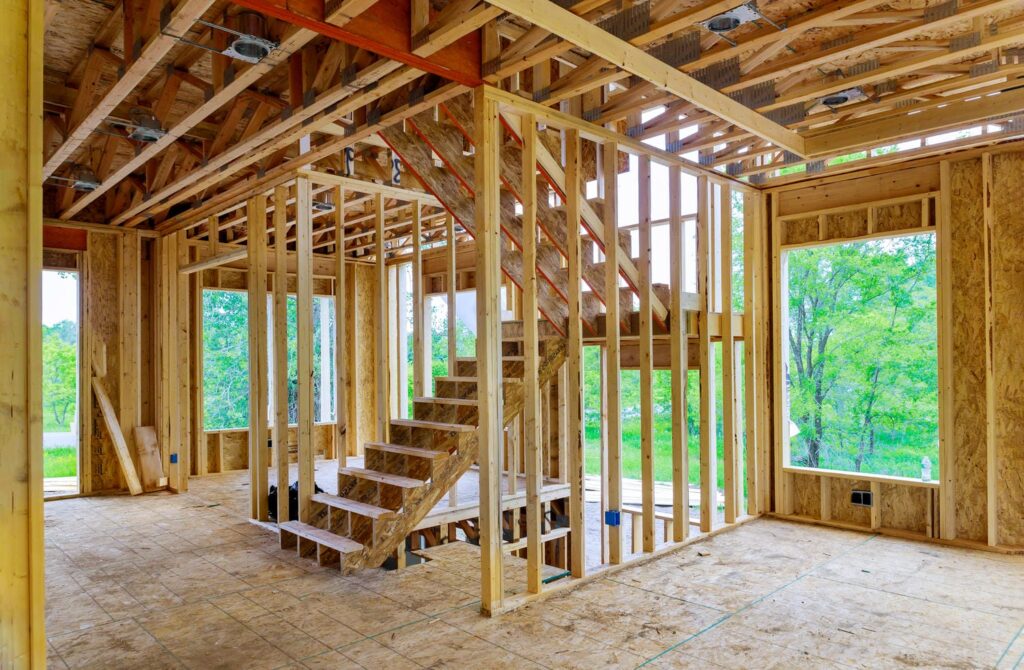
Lumber choice affects more than the structure. It can influence room feel, ceiling planes, duct routes, plumbing runs, electrical paths, floor depth, inspection documents, and the sequence of trades. A good framing material package supports the architecture and the build process at the same time.
On a custom home, this coordination should happen before the lumber package is ordered. Once material is on site, changes become more expensive, and crews may lose time waiting for revised details or replacement members.
Open Spans, Ceiling Heights, And Room Feel
Engineered beams and joists can support open-concept areas, large glazing, and fewer intermediate supports when designed correctly. This can help preserve long sightlines, cleaner room layouts, and open main floors that would be harder to frame with conventional lumber alone.
However, longer spans can also require deeper members, different ceiling drops, or more coordination with mechanical systems. A beam that solves one structural problem can create a ceiling or duct conflict if the design team does not coordinate early.
The structural solution needs to fit the architecture, not fight it. That is where early review by the builder, engineer, supplier, and framing crew can prevent awkward site fixes.
Mechanical Routing, Holes, Notches, And Chases
Mechanical, plumbing, electrical, and sprinkler rough-ins are all affected by framing material. Dimensional joists and studs have limits around holes and notches. I-joists may allow web openings, but only in permitted zones and sizes.
Engineered members should not be cut, drilled, notched, or altered casually. A hole in the wrong place can damage the member and create a structural issue. The crew should follow supplier details and ask for engineering direction when a field condition does not match the plan.
This is especially important in custom homes with tight ceiling heights, hidden mechanical runs, recessed lighting, and large open rooms. Services need clear paths, but the structure still has to do its job.
Foundation-To-Framing Handoff
Lumber choice connects back to the foundation because loads have to land somewhere. Engineered beams, point loads, tall walls, shear details, and large openings may all require clear bearing points, hold-downs, anchor bolts, or foundation alignment.
If those items are missed during forming, the framing crew can inherit problems that are harder to correct. That is why residential foundation forming should be coordinated with the framing plan instead of treated as a separate phase.
A clean handoff helps the crew frame faster and with more confidence. It also reduces the chance of delays when the inspector or engineer reviews the load path.
How Lumber Choice Affects Cost, Schedule, And Ordering
Most owners ask whether engineered lumber costs more than dimensional lumber. That is a fair question, but it is not the whole question. The better question is whether the selected material solves the design need cleanly, protects the schedule, and reduces rework.
A cheaper member is not always cheaper for the project. If it adds posts, slows installation, complicates mechanical routing, or creates finish issues, the cost can show up later.
Material Cost Vs Labour Value
Engineered lumber can cost more per piece, but it may reduce labour or solve a structural problem more cleanly. A single engineered beam may replace a more complicated built-up solution. An I-joist layout may create a more consistent floor system and clearer routes for services.
Dimensional lumber is often more economical in standard framing locations. It works well where the design is repetitive, the spans are modest, and field flexibility is useful.
The best material decision looks at total value. That includes the lumber price, installation time, waste, delivery, handling, lead time, rework risk, and the finished result.
Lead Times, Shop Drawings, And Supplier Layouts
Engineered lumber often needs more ordering discipline. I-joist layouts, beam schedules, truss packages, special hangers, and supplier drawings may need review before installation begins. If the design changes late, the material package may need to change too.
This affects the framing sequence. A missing beam or delayed hanger can stall a crew even if most of the lumber is on site. The best time to catch those issues is during drawing review, not after the crew is ready to stand walls.
Custom framing works better when material ordering, field sequencing, and supplier coordination are handled before crews are waiting on site. That is where organized planning protects both budget and schedule.
Waste, Delivery, Handling, And Site Access
Engineered members can be long, heavy, and sensitive to poor handling. They may need a clear delivery area, lift planning, dry storage, and protection from damage. If a long beam arrives with no place to land, the site can slow down before installation begins.
Dimensional lumber also needs sorting and protection, especially on wet Lower Mainland sites. Poor stacking, muddy access, or disorganized delivery can create waste and frustration before the frame is even underway.
A good crew thinks about how material lands on site, how it moves through the frame, and how it is protected until installed. Site organization is part of quality control.
Code, Engineering, And Inspection Considerations In BC

Framing material choices are governed by approved drawings, engineering, manufacturer limits, supplier layouts, and local authority requirements. The framer should build to the approved package and raise questions when field conditions do not match the documents.
Engineered lumber and dimensional lumber both need to be installed within the rules that apply to the project.
Approved Drawings Come Before Field Preference
The framing crew should build to the approved drawings and structural details. The Province of B.C. notes that the BC Building Code 2024 came into effect on March 8, 2024, and applies to projects with building permits applied for after that date. The Province also notes that BC Codes do not apply in the City of Vancouver because Vancouver has its own building bylaw.
That matters for custom homes across Vancouver, Burnaby, Richmond, Surrey, Coquitlam, New Westminster, Delta, Langley, Port Moody, and the rest of the Lower Mainland. The correct material package should come from the approved drawings, the authority having jurisdiction, and the project’s engineering team.
Field preference is not enough. If a substitution looks practical on site, it still needs the right review before it is installed.
Engineered Members May Need Specific Documentation
Engineered beams, I-joists, trusses, and proprietary members often come with layouts, installation details, supplier notes, engineering stamps, or manufacturer limits. Those documents should be current and available for the builder, framer, engineer, and inspector.
The National Research Council Canada’s CCMC evaluation reports for alternative floor joists note that revised engineered wood joist evaluation reports include manufacturer fire test data and direction to provide fire test information to Authorities Having Jurisdiction. Proprietary products can carry documentation requirements beyond the lumber order itself.
The framing crew does not need to turn the site into a product library, but the right documents need to be available when the project requires them. Missing layouts, unclear revisions, or incomplete supplier details can slow the frame and the inspection path.
Inspections Need Visible, Documented Work
Engineered lumber can help the structure meet design goals, but it still needs clean installation and documentation. Inspectors or field reviewers may need to see bearing, connectors, hangers, blocking, fire protection conditions, truss documents, I-joist layouts, and engineer letters where required.
Material choice connects to inspection readiness. If an engineered member is hidden, altered, or undocumented, the project may face delays before cover-up. A strong framing crew keeps critical details visible until they are reviewed.
Knowing what gets checked at framing rough-in inspections in BC helps the crew plan for cover-up without delays.
Moisture, Storage, And Jobsite Protection In The Lower Mainland
Vancouver and Lower Mainland framing often happens in rain, damp air, tight access, and active neighbourhoods. Material performance depends not only on what is specified, but how it is protected, sorted, staged, and installed.
No lumber package benefits from neglect. Dimensional lumber and engineered lumber both need a site plan that accounts for delivery, storage, weather, mud, access, and installation order.
Dimensional Lumber Still Needs Sorting And Protection
Dimensional lumber should be sorted, crowned, and protected from unnecessary moisture exposure. Some pieces are better suited for blocking, backing, or temporary bracing than for high-precision wall framing. That decision happens on site.
Experienced carpenters know that lumber selection is part of quality control. The straighter pieces should go where straightness matters most. Crowns should be managed. Damaged or poor-quality pieces should not be forced into critical locations.
This kind of field discipline shows up later in the finish. Drywall, trim, cabinets, windows, and cladding all benefit when the frame is straight and the material is used with care.
Engineered Lumber Needs Manufacturer-Aware Handling
Engineered products should be handled according to supplier or manufacturer instructions. I-joists, LVLs, PSLs, LSLs, and glulam may have rules for storage, lifting, notching, drilling, bearing, bracing, and exposure.
The safest guidance is simple: follow the approved drawings and supplied installation details. Do not assume every engineered member can be treated the same way. A glulam beam, an I-joist, and an LVL header each have different handling and installation concerns.
If a member is damaged, swollen, cut incorrectly, or exposed beyond the expected conditions, the builder and engineer should be notified. Guessing in the field can create bigger problems later.
A Clean Site Protects The Frame And The Schedule
Tight custom home sites need organized staging. Long engineered members need room. Dimensional lumber needs sorting. Wet weather needs a plan. Poor material handling can lead to delays, damaged members, reordering, or field confusion.
A clean site also helps the crew work safely and efficiently. When material is staged in the right order, the team spends less time moving piles and more time building the frame.
That organization supports a calmer construction experience. The more predictable the site feels, the easier it is for the owner, builder, and trades to enjoy each step of the journey.
How We Help Select And Install The Right Framing Materials
Our team helps custom home teams turn structural drawings and material packages into clean field execution. We do not replace the engineer, designer, or municipal authority. We help interpret, coordinate, install, and protect the framing package on site.
That includes reviewing the drawings, understanding the load path, coordinating with the supplier, planning the site sequence, and checking how engineered and dimensional lumber work together in the frame.
Red Seal-Led Field Leadership
Red Seal carpenters leading work in the field help catch issues before they become installation problems. That includes reading beam schedules, reviewing layouts, checking bearing points, coordinating hangers and connectors, and identifying questions before material is cut.
We are also an ITA-approved Red Seal Carpentry training authority. That supports consistent crew standards, better site habits, and clearer expectations across the framing team.
On a custom home, that training matters. Complex framing is not just about lifting the biggest beam into place. It is about building the whole structure with care, from the first plate to the final roof detail.
Combined Forming And Framing Perspective
Material selection does not start when lumber arrives. Foundation layout, point loads, anchor bolts, hold-downs, bearing walls, slab edges, and wall heights all affect how engineered and dimensional lumber are installed.
Our combined forming and framing experience helps us see that connection early. A crew that understands both sides can coordinate the structure from concrete to frame more cleanly.
That is especially useful when engineered beams, tall walls, large openings, and architectural details need to line up with the foundation below. The fewer surprises at that handoff, the smoother the framing stage feels.
Best Fit Projects
Our best fit projects include complex custom homes, architectural builds, heritage renovations, large openings, long-span spaces, and Lower Mainland projects where access and sequencing need careful leadership.
We are owner-led by Luke Creten, in business since 2013, and built around stable crews with low turnover. That gives builders and owners a more consistent field experience from planning through execution.
We are Vancouver-based and serve the Lower Mainland, including Vancouver, Burnaby, Richmond, New Westminster, Coquitlam, Port Moody, Surrey, Delta, Langley, and Anmore.
Plan Your Custom Home Frame With The Right Material Mix
Choosing between engineered lumber and dimensional lumber is not about picking the most expensive product or the most familiar one. It is about matching the material to the design, load path, site conditions, rough-in needs, and inspection sequence.
Anvil West brings Red Seal-led framing, combined forming-to-framing experience, stable crews, and owner-led coordination to custom homes across Vancouver and the Lower Mainland. To review your framing scope before the lumber package is locked in, speak with our custom home framing team.
Book a consultation before your framing material package is ordered.
Frequently Asked Questions
Is Engineered Lumber Better Than Dimensional Lumber?
Not always. Engineered lumber is often better for long spans, beams, large openings, and floor systems that need predictable performance. Dimensional lumber is still a strong fit for many studs, plates, blocking, short spans, and conventional framing details. A strong custom home frame usually uses both, and the right choice depends on the approved drawings, load path, span, site conditions, finish expectations, and trade coordination.
What Is Dimensional Lumber In Home Framing?
Dimensional lumber is sawn lumber in standard sizes, such as 2×4, 2×6, 2×8, 2×10, and 2×12. It is commonly used for wall studs, plates, blocking, rafters, joists, backing, and many everyday framing details. It remains important on custom homes because much of the structure still depends on accurate, repeated carpentry, and even when engineered beams and I-joists are used, dimensional lumber usually makes up a large part of the frame.
Where Is Engineered Lumber Used In A Custom Home?
Engineered lumber is commonly used for I-joist floor systems, LVL beams, PSL columns or beams, LSL studs or rim material, glulam beams, large headers, long spans, and heavily loaded framing areas. These products are often specified where the design needs open rooms, large glazing, fewer posts, straighter members, or predictable structural performance, and they should be installed according to the approved drawings and supplier details.
Is Engineered Lumber More Expensive?
Engineered lumber can cost more per piece, but it may reduce labour, improve performance, or make a design possible without extra posts or complicated built-up framing. The real cost depends on the drawings, supplier package, member size, lead time, site access, and installation complexity, so the best choice looks at total project value, not just the unit price of each member.
Can Engineered Lumber Get Wet During Framing?
Engineered lumber should be protected and handled according to supplier or manufacturer instructions. Short-term exposure may be expected on active sites, but standing water, damage, swelling, or improper storage can create problems that need review, and on Lower Mainland sites material should be staged, covered, and installed in a way that protects the frame and schedule.
Can You Drill Holes In Engineered Lumber?
Only where the approved drawings, supplier layout, or manufacturer instructions allow it. I-joists may have permitted web opening zones, but beams, flanges, and other engineered members should not be cut, drilled, or notched casually, and if a trade route conflicts with an engineered member the project team should ask for the right direction before altering it.
Who Decides Whether To Use Engineered Or Dimensional Lumber?
The structural engineer and approved drawings usually determine the structural material package, while the builder, framer, architect, and supplier can help with buildability, sequencing, ordering, and coordination. Structural substitutions should be reviewed before installation, because a field change that looks simple can affect loads, spans, connectors, inspections, and the final approval path.
Does Lumber Choice Affect Framing Inspections?
Yes. Inspectors and field reviewers may need to see that beams, joists, trusses, hangers, blocking, bearing points, and engineered layouts match the approved documents, and material choice can also affect what drawings, letters, supplier layouts, or installation details need to be available on site. Clean documentation helps the project move toward cover-up with fewer delays.